Best Pruning Blades for Reciprocating Saw of 2026
This guide dives deep into the world of reciprocating saw pruning blades, helping you navigate the various options available. We’ll explore key features like tooth design, material, and length, ensuring you select the ideal blade to tackle everything from delicate shrub trimming to heavy-duty limb removal, making your outdoor maintenance tasks faster, cleaner, and ultimately more effective.
1. EZARC 15-Inch Japanese Teeth Pruning Blade
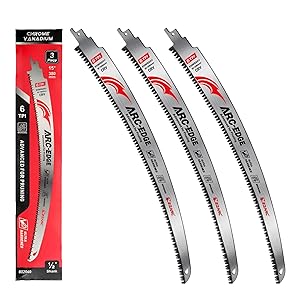
- Blade Length: 15 inches (370mm total, 320mm working)
- Tooth Profile: 6 TPI (Japanese, triple-ground offset)
- Cutting Capacity: Up to 300mm diameter (wet/dry wood, green timber)
- Shank Type: Universal (not compatible with Ryobi)
The EZARC Japanese Teeth Reciprocating Saw Blade is engineered for superior pruning performance, boasting a remarkable 15-inch length and an aggressive Japanese tooth profile. This design facilitates an incredibly efficient and clean cut, surpassing the speed and effectiveness of standard pruning blades. Its innovative arc edge, combined with triple-ground offset teeth, creates three distinct cutting angles.
This unique geometry significantly reduces friction, ensuring a smooth and highly controlled cut, particularly when tackling larger, tougher branches and limbs. The fleam-ground teeth are not only exceptionally sharp but also feature deep gullets, optimizing chip removal and contributing to a cutting efficiency that makes quick work of demanding pruning tasks.
- Pros:
- Efficient & clean, super-fast cuts
- Innovative arc edge reduces friction
- Durable fleam-ground teeth for longer life
- Cons:
- Not compatible with Ryobi saws
- Longer length can be less maneuverable in tight spaces
2. Diablo Demo Demon Carbide Pruning Blades (9-inch)

- Blade Length: 9 inches
- Tooth Profile: 3 TPI (Carbide Tipped, aggressive geometry)
- Coating: Perma-SHIELD Non-Stick
- Material: TiCo Hi-Density Carbide
The Diablo Demo Demon Carbide Tipped Reciprocating Saw Blades redefine durability and performance for pruning and clean wood applications. Featuring an aggressive carbide tooth geometry, these 9-inch blades deliver an unmatched 50 times longer cutting life compared to standard blades, significantly boosting productivity.
Diablo’s proprietary TiCo Hi-Density Carbide is at the heart of their superior performance, ensuring maximum durability and consistent, powerful cuts across a wide spectrum of wood types. The design incorporates large gullets and a strengthened, oversized blade body, which are crucial for efficient chip removal, preventing binding and maintaining cutting speed even in the most extreme cutting scenarios.
- Pros:
- Exceptional 50x longer cutting life
- Aggressive carbide teeth for fast, effortless cuts
- Perma-SHIELD coating prevents gumming
- Cons:
- Premium price point
- Optimized specifically for wood, less versatile for other materials
3. HORUSDY 9-Inch 5TPI Wood Pruning Blades

- Quantity: 5-Pack
- Blade Length: 9 inches
- Tooth Profile: 5 TPI
- Material: HCS (High Carbon Steel)
The HORUSDY 9-Inch Wood Pruning Reciprocating Saw Blades offer a practical and economical solution for various wood cutting and pruning tasks. This convenient 5-pack ensures you have multiple blades on hand, minimizing interruptions during larger projects.
Crafted from High Carbon Steel (HCS), these blades are built for faster cutting through wood and provide enhanced durability, standing up to the demands of outdoor use. Their advanced alloy and tooth designs contribute to remarkably smoother cuts, making them well-suited for fast, rough cutting of wood and efficient pruning of branches in your garden or yard.
- Pros:
- Cost-effective 5-pack
- Durable HCS construction for wood cutting
- Designed for smoother cuts
- Cons:
- HCS may not last as long as carbide blades
- 9-inch length can be limiting for very thick limbs
4. WORKPRO 6/9-Inch Pruning Reciprocating Saw Blade Set (10 Pieces)

- Quantity: 10-piece set (5x 6-inch, 5x 9-inch)
- Tooth Profile: 5 TPI (grinding teeth design)
- Material: HCS (High Carbon Steel)
- Cutting Capacity: 6″ for <100mm, 9″ for <150mm
The WORKPRO Wood Pruning Reciprocating Saw Blade Set provides an excellent comprehensive solution for varied pruning and wood cutting needs, offering a generous 10-piece collection. This set includes five 6-inch blades and five 9-inch blades, both with a 5TPI profile, making it highly versatile for tackling branches of different sizes.
The 6-inch blades are ideally suited for branches up to 100mm in diameter, while the 9-inch blades efficiently handle limbs up to 150mm, ensuring you have the right tool for most common garden maintenance tasks. Crafted from high-carbon steel (HCS), these blades boast impressive hardness and wear resistance, specifically designed for cutting wet wood and green branches with sustained performance.
- Pros:
- Versatile set with two blade lengths
- High quantity (10 pieces) for value
- Efficient grinding teeth for smooth cuts
- Cons:
- HCS may have a shorter lifespan than carbide
- Max cutting capacity limited for very large limbs
5. Diablo 12-Inch Pruning Reciprocating Saw Blade

- Quantity: 5-Pack
- Blade Length: 12 inches
- Tooth Profile: 5 TPI (Precision Fleam Ground)
- Cutting Direction: Bi-directional
The Diablo 12-Inch Pruning Reciprocating Saw Blade, available in a convenient 5-pack, is engineered for reliable and efficient wood cutting and pruning. Each blade features a hardened cutting edge, specifically designed to extend the blade’s lifespan and ensure consistent, durable performance through countless cuts.
This robust construction makes them a dependable choice for regular outdoor maintenance tasks, from trimming overgrown branches to preparing firewood. A standout characteristic of these blades is their innovative bi-directional cutting capability. This design allows for fast and smooth cutting action in both directions of the saw’s stroke, significantly accelerating the cutting process and reducing overall effort.
- Pros:
- Hardened cutting edge for enhanced durability
- Bi-directional cutting for faster operation
- Precision fleam ground teeth ensure reliable cuts
- Cons:
- Not carbide-tipped, potentially shorter lifespan in extreme conditions
- 5 TPI might be less aggressive than lower TPI for very thick wood
6. Goshine 9-Inch Wood Pruning Reciprocating Saw Blades
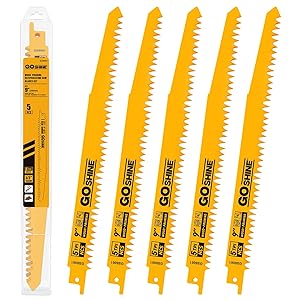
- Quantity: 5-Pack
- Blade Length: 9 inches
- Tooth Profile: 5 TPI (Dual-Sided Sharpened)
- Material: Next-Gen High-Carbon Steel
The Goshine 9-Inch Wood Pruning Reciprocating Saw Blades, offered in a practical 5-pack, bring an impressive blend of durability and cutting efficiency to your pruning tasks. Crafted from next-generation high-strength carbon steel, these blades are engineered for superior wear resistance and hardness.
Their substantial 0.05-inch thick body maintains sharpness longer and effectively resists bending or breakage, promising up to twice the lifespan of conventional blades, which translates to better value and fewer replacements over time. A standout feature is the Dual-Angle Tooth Drive Technology, where alternating teeth are set at two optimized cutting angles. This innovative design not only significantly increases cutting speed but also ensures remarkably smoother and more controlled cuts through wood and branches, substantially reducing the effort required.
- Pros:
- Up to 2x longer lifespan with advanced HCS
- Dual-Angle Tooth Drive for faster cutting
- Dual-sided sharpened teeth for aggressive removal
- Cons:
- Not carbide-tipped for ultimate durability
- 9-inch length may be limiting for extremely large limbs
7. Milwaukee The Ax 9-Inch 5 TPI Reciprocating Saw Blades

- Quantity: 5-Pack
- Blade Length: 9 inches
- Tooth Profile: 5 TPI (optimized for material removal)
- Material: Shatter-resistant Bi-Metal
The Milwaukee 48-00-5026 The Ax 9-Inch Reciprocating Saw Blades, available in a durable 5-pack, are purpose-built for heavy demolition work, but their robust design makes them equally formidable for challenging pruning tasks, especially those involving wood with nails or bolts.
The aggressive 5 TPI geometry is optimized to remove more material per stroke, translating to significantly faster cutting speeds, which is a major advantage when tackling dense or fibrous wood. These blades excel in plunge cutting, allowing for quick and precise entry into restricted areas, a crucial feature for intricate pruning or demolition work.
- Pros:
- Excellent for fast plunge cutting
- Extra thick blade body for maximum robustness
- Ideal for wood with nails & bolts
- Cons:
- Not carbide-tipped for ultimate wear resistance
- 9-inch length might be limiting for very large trunks
How to Choose Pruning Blades For Reciprocating Saw
The reciprocating saw is a powerful and versatile tool, a true workhorse in any toolkit. While often associated with demolition, it transforms into an indispensable gardening companion when fitted with the right blade. For effective and efficient pruning, selecting the best blade isn’t just about grabbing the first one you see; it’s about understanding the nuances that separate a smooth, clean cut from a struggle. This comprehensive guide will walk you through all the critical factors to consider, ensuring you choose the perfect pruning blades for your reciprocating saw, making your yard work easier, faster, and more satisfying.
Why a Reciprocating Saw for Pruning?
Before diving into blade specifics, let’s briefly consider why a reciprocating saw is an excellent choice for pruning tasks. Its powerful motor delivers rapid, back-and-forth strokes, allowing it to cut through wood with impressive speed. This makes it far more efficient than manual hand saws for anything beyond very small branches. Furthermore, its relatively compact size and maneuverability, especially compared to bulkier tools like chainsaws, make it ideal for navigating through dense foliage or reaching awkward spots in trees and shrubs. When combined with specialized pruning blades, a reciprocating saw offers a balance of power, precision, and convenience that few other tools can match for garden and landscape maintenance. It allows users to tackle a wide range of tasks, from thinning out overgrown bushes to removing significant tree limbs, all with a single tool, thereby streamlining your outdoor work and saving valuable time and effort.
Key Factors When Choosing a Pruning Blade
Selecting the ideal pruning blade involves understanding several crucial characteristics that influence its performance, durability, and suitability for specific tasks. Paying attention to these details will ensure you invest in blades that not only get the job done but do so efficiently and safely.
Blade Material
The material of your pruning blade is fundamental to its strength, durability, and cutting efficiency. High Carbon Steel (HCS) blades are generally the most affordable option. They are flexible and good for general wood cutting, particularly green wood, which tends to be softer. While decent for occasional pruning, they wear down faster and are more susceptible to bending or breaking. Bi-metal blades combine the flexibility of HCS with the hardness of high-speed steel (HSS) teeth. This construction makes them significantly more durable and shatter-resistant, handling a wider range of wood types, including some with embedded nails. Carbide-tipped blades are the top tier for durability and performance. Their extremely hard carbide teeth maintain sharpness for an exceptionally long time, excelling at cutting through very hard wood, old wood, and even wood with metal inclusions. While more expensive, their extended lifespan makes them a cost-effective investment for heavy-duty or professional use.
Blade Length
The length of the blade directly impacts its reach and the size of the branches it can effectively cut. Shorter blades (6-9 inches) offer greater maneuverability and control, ideal for tight spaces, smaller branches, and shrubs where precision is key. Medium blades (10-12 inches) are versatile, suitable for most common pruning tasks and medium-sized branches, providing a good balance of reach and control. Long blades (15+ inches) are designed for heavy-duty pruning and cutting large limbs or small tree trunks, offering maximum reach and capacity for significant tasks, though they can be less maneuverable in confined areas.
Teeth Per Inch (TPI) and Tooth Geometry
The TPI and the shape of the teeth are critical for the speed and smoothness of the cut. Blades with a low TPI (3-5 TPI) have fewer, larger teeth designed for aggressive, fast cutting, especially through thick, green, or wet wood, with large gullets clearing chips efficiently, though the cut will be rougher. Higher TPI blades (6-10 TPI) feature more, smaller teeth for cleaner, smoother cuts, better for smaller branches or when a finer finish is desired, but typically slower. Many pruning blades also feature specialized tooth geometries like Japanese teeth (often triple-ground for aggressive, clean cuts) or fleam ground teeth (sharpened on both sides for efficient bi-directional cutting) to optimize performance.
Other Important Considerations
Most reciprocating saw blades use a universal shank (1/2-inch shank), fitting the majority of popular brands, but always confirm compatibility. Blade thickness also matters; thicker blades (e.g., 0.05 inches) offer greater rigidity and resistance to bending for heavy-duty applications, while thinner blades are more flexible but prone to snapping. Finally, some premium blades come with special coatings that reduce friction and prevent sap and resin buildup, leading to faster, cooler cuts and extending blade life, especially when cutting green or sappy wood.
Matching Blades to Pruning Tasks
Matching the blade to the task ensures optimal results and tool longevity. For light pruning on shrubs, bushes, and small branches (up to 2 inches), a shorter (6-9 inch) blade with a higher TPI (6-8 TPI) is ideal for control and cleaner cuts. For medium branches and limbs (2 to 6 inches), a medium-length (9-12 inch) bi-metal blade with 4-5 TPI offers a good balance of speed and control. When tackling heavy-duty tasks like large limbs (6 inches or more) or small tree trunks, opt for a long (12-15+ inch) carbide-tipped blade with a low TPI (3-4 TPI) for aggressive cutting. For green wood, blades with large gullets and low TPI are best for chip removal; for harder dry wood, carbide-tipped or bi-metal blades with good wear resistance are effective.
Maintenance and Safety Tips
Proper care and safe operation are paramount. Always clean your blades after each use to remove sap and debris, storing them in a dry place to prevent rust and damage. Generally, sharpening pruning blades is not recommended; it’s often more cost-effective to replace them when they dull. For safety, always wear appropriate personal protective equipment (PPE), including safety glasses, gloves, and hearing protection. Ensure the branch is stable to prevent kickback, maintain a firm grip on the saw, and never force the blade. Let the tool do the work, and if the blade binds, release the trigger and safely remove the saw before attempting to free the blade.
Conclusion
Choosing the best pruning blades for your reciprocating saw doesn’t have to be complicated. By considering the blade’s material, length, TPI, and specific tooth geometry, you can equip your saw to handle any pruning challenge your garden throws its way. Whether you’re a homeowner maintaining a tidy yard or a professional landscaper tackling demanding jobs, investing in the right blades will not only make your work easier and faster but also yield cleaner cuts and extend the life of your valuable tools. Remember, a sharp, appropriate blade is the key to efficient and satisfying pruning.