Best Grow Lights For Hydroponics of 2026
Optimizing plant growth in a hydroponic system hinges significantly on providing the right illumination. Grow lights are indispensable for indoor gardeners, simulating natural sunlight to support photosynthesis and ensure healthy development from seedling to harvest. With a myriad of options flooding the market, selecting the best grow lights for hydroponics can be a daunting task.
1. Hlite 16inch LED Grow Lights

- Spectrum: Full Spectrum LED
- Power Consumption: 20W total (replaces 120W incandescent)
- PPFD: High PPFD for optimal absorption
- Linkability: Up to six units
The Hlite 16-inch 4-Pack LED Grow Lights offer a convenient and versatile solution for indoor hydroponic gardeners looking to provide their plants with essential illumination. These full-spectrum lights are engineered to mimic natural sunlight, delivering the precise wavelengths needed to support plant growth through all stages, from delicate seedlings to vigorous flowering and fruiting. Despite their compact size, they boast a super bright output with high PPFD (Photosynthetic Photon Flux Density), ensuring that over 95% of the emitted light energy is absorbed by your plants for efficient photosynthesis.
Installation is designed to be hassle-free with a simple plug-and-play setup, making them accessible even for beginners. The linkable design allows you to connect up to six units from a single power source, providing scalability for growing setups on shelves, in grow boxes, or greenhouses. The kit comes complete with various mounting accessories, including screws, hooks, chains, zip ties, and brackets, offering flexibility for different environments.
- Pros:
- Full spectrum for all growth stages
- Energy-efficient (20W total)
- Easy plug-and-play installation
- Cons:
- Might be too small for very large setups
- Individual units are relatively short
2. Barrina Plant Grow Lights

- Spectrum: 5000K Full Spectrum Daylight White
- Power Consumption: 252W total (6 x 42W)
- LED Count: 1152 LEDs total
- Linkability: Up to 6 grow light strips
The Barrina Plant Grow Lights, offered as a 6-pack of 4-foot T8 LED strips, provide a robust and highly effective lighting solution for larger indoor hydroponic setups. These lights deliver a 5000K full-spectrum daylight white, which is specifically formulated to provide the most reasonable grow light wave for optimal plant absorption across all growth stages – from seeding to robust growth and abundant bloom. With a total consumption of only 252W from 1152 LEDs across the six strips, they are remarkably energy-efficient, capable of replacing 1400W equivalent traditional grow light bulbs while significantly reducing electricity costs.
A standout feature is the V-shaped reflector design, which actively enhances light efficiency by 17-20%, directing more light directly onto your plants for increased intensity. The light’s casing is constructed from 100% aluminum, ensuring high-efficiency heat dissipation that contributes to a longer lifespan for the LED chips. Installation is designed for ease, coming with all necessary accessories like tape, clips, and cable ties, allowing for a quick setup in minutes.
- Pros:
- High energy efficiency
- Full spectrum for all plant stages
- V-shaped reflector boosts intensity
- Cons:
- New vs. old product compatibility issues
- Fixed 5000K spectrum, no dimming
3. Wiaxulay LED Grow Light Strips with Timer

- Spectrum: 6000K Full Spectrum with 660NM
- LED Count: 240 LEDs per strip (2-pack)
- Timer: 6H, 12H, 16H cycle memory
- Dimming: 5 adjustable levels (10% to 100%)
The Wiaxulay LED Grow Light Strips, offered as a convenient 2-pack, provide a comprehensive and user-friendly lighting solution for a variety of indoor hydroponic and plant shelf setups. Emitting a full spectrum of 6000K, coupled with 660nm red light, these strips closely mimic natural sunlight, delivering all the necessary wavelengths from 380nm to 800nm to effectively promote growth across all plant stages. This broad spectrum ensures your plants receive the optimal light for everything from germination to flowering and fruiting, making them highly versatile for succulents, herbs, vegetables, and more.
A significant advantage of the Wiaxulay strips is their integrated cycle memory timer, offering settings for 6, 12, or 16 hours. Once set, the lights will automatically turn on and off daily, providing consistent light cycles without manual intervention – a crucial feature for plant health and simplifying your gardening routine. Furthermore, the inclusion of five adjustable brightness levels, from 10% to 100%, allows you to precisely tailor the light intensity to meet the specific requirements of different plants at various growth phases.
- Pros:
- Full 6000K sunlike spectrum
- Integrated cycle memory timer
- 5 adjustable dimming levels
- Cons:
- Timer requires continuous power supply
- Individual strips are relatively short (16 inches)
4. KingLED KP1000 LED Grow Light
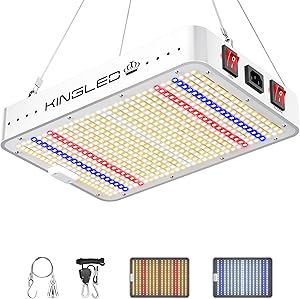
- Spectrum: Full Spectrum (Red, Blue, White, Yellow)
- LED Count: 640 LEDs (40 red, 40 blue, 280 white, 280 yellow)
- Power Consumption: 100W true power
- Coverage Area: 2×2 ft
The KingLED KP1000 LED Grow Light is a powerful and versatile lighting solution specifically designed for indoor hydroponic plants within a 2x2ft coverage area, making it ideal for grow tents and smaller setups. This 100W light features an impressive 640 LEDs, including a carefully balanced mix of red, blue, white, and yellow diodes to deliver a high PAR output and a natural sunlight-like full spectrum. This comprehensive spectrum ensures that plants receive optimal light wavelengths for all growth stages, promoting robust photosynthesis and leading to healthy development from seed to fruit.
One of the standout features of the KP1000 is its three distinct growth modes: Veg, Bloom, and Veg & Bloom. This allows growers to precisely tailor the light spectrum and intensity to the specific needs of their plants at each stage, optimizing growth and maximizing yields. The unit is remarkably energy-efficient, consuming only 100 watts while matching the performance of much higher wattage traditional grow lamps, translating to significant electricity savings.
- Pros:
- Targeted 2x2ft coverage
- Full spectrum with high PAR output
- Three specialized growth modes
- Cons:
- Limited to 2x2ft coverage area
- Fans, though quiet, are present
5. FECiDA 600W Equivalent Dimmable LED Grow Light

- Power: 65W true power (600W equivalent)
- Spectrum: Balanced Full-Spectrum (380–780 nm)
- Dimming: 0–100% stepless dimming
- Connectivity: Daisy chain up to 8 lights
The FECiDA 600W Equivalent LED Grow Light offers a powerful yet energy-efficient solution for indoor hydroponic cultivation, delivering the intensity of a 600W traditional HPS lamp while consuming only 65W of real power. This significant power saving makes it an economically sound choice for growers. It provides a balanced full-spectrum output (380–780 nm), carefully designed to support plants through all critical stages: seedling, vegetative growth, and bloom.
A key feature enhancing its versatility is the 0–100% smooth dimming knob, allowing growers to precisely adjust light intensity according to their plants’ specific needs at different growth phases, preventing light burn for young seedlings or maximizing intensity for robust flowering. The light also includes a convenient daisy chain design, enabling you to connect up to eight units from a single power outlet, simplifying complex setups for larger grow tents or commercial operations.
- Pros:
- Highly energy-efficient (65W true power)
- Full spectrum for all growth stages
- Stepless 0-100% dimming control
- Cons:
- Fan, though quiet, is present
- Coverage area not explicitly stated
6. MARS HYDRO TS600 100W LED Grow Light

- Power Consumption: 100W true power
- LED Count: 225 LEDs
- Spectrum: Full Spectrum (730-740nm Red IR / 3200-4200K / 5200-6800K)
- Coverage: Ideal for 2x2ft grow tent
The MARS HYDRO TS600 100W LED Grow Light is an exceptional choice for beginners and experienced growers alike, specifically optimized for 2x2ft grow tents and various indoor hydroponic setups. Featuring a newly designed diode layout that’s densely packed in the center and more sparse on the sides, this light ensures a remarkably uniform light distribution across the entire canopy. This meticulous design guarantees an even PPFD (Photosynthetic Photon Flux Density), maximizing light absorption by plants and contributing to higher yields.
Equipped with a sunlike full spectrum (730-740nm Red IR, 3200-4200K, and 5200-6800K), the TS600 provides the ideal light composition for all plant stages, from rapid seedling response to bountiful flowering. Over 90% of its light energy is absorbed by plants, promoting strong, healthy growth and improved crop quality. Utilizing advanced SMD LED technology, this light consumes only 100W with 225 LEDs.
- Pros:
- Optimized diode layout for uniform PPFD
- Wide coverage with 120° reflector
- Sunlike full spectrum for all stages
- Cons:
- Only suitable for 110-130V voltage
- Limited to 2x2ft coverage area
7. Spider Farmer SF1000 Samsung LM301H EVO LED Grow Light

- LED Chips: Samsung LM301H EVO (3.14 µmol/J PPE)
- Spectrum: Full Spectrum (3000K, 5000K, 660nm, IR 760nm)
- Dimming: Adjustable knob, compatible with GGS controllers
- Coverage: 2x2ft / 3x3ft grow tent
The Spider Farmer SF1000 stands as a pinnacle of LED grow light technology, harnessing cutting-edge Samsung LM301H EVO LEDs that boast an impressive efficiency rating of 3.14 µmol/J PPE per diode. These premium diodes surpass even renowned chips like LM301B and LM301H in effectiveness, offering superior light quality and a more potent blue spectrum for unprecedented plant growth enhancement. This makes the SF1000 an exceptional choice for serious hydroponic growers seeking to maximize yield and plant vitality.
The 2025 New Version SF1000 features an optimized diode layout where diodes are gathered at the edge, promoting more uniform PPFD distribution and enhancing light absorption for higher yields. Its dimming knob allows for precise light intensity adjustments, and its compatibility with GGS controllers enables automated dimming and on/off cycling based on plant growth stages, a boon for multi-light setups and commercial operations.
- Pros:
- Industry-leading Samsung LM301H EVO LEDs
- Optimized full spectrum for all growth stages
- Dimmable with controller compatibility
- Cons:
- Higher initial investment cost
- IR light is dimmer and requires protective eyewear
How to Choose Grow Lights For Hydroponics
Hydroponics, the art of growing plants without soil, relies heavily on providing an optimized environment, and perhaps no factor is more critical than light. Since natural sunlight is often inaccessible or insufficient for indoor setups, grow lights become the lifeblood of your hydroponic garden. Choosing the right grow light is paramount for healthy plant development, maximizing yields, and ensuring energy efficiency. This comprehensive guide will walk you through the essential considerations to help you select the perfect lighting solution for your hydroponic system.
Understanding Plant Lighting Needs
Before diving into specific grow light technologies, it’s crucial to understand what plants need from light. Plants primarily utilize light for photosynthesis, the process by which they convert light energy into chemical energy for growth. This process is influenced by several aspects of light:
Light Spectrum
The “full spectrum” for plant growth refers to the range of light wavelengths that are beneficial for photosynthesis. While sunlight provides a broad spectrum, different wavelengths play specific roles:
- Blue Light (400-500 nm): Essential for vegetative growth, strong stems, and dense foliage. It promotes chlorophyll production and plays a role in phototropism (plants growing towards light).
- Red Light (600-700 nm): Crucial for flowering, fruiting, and overall biomass. It influences stem elongation and seed germination. Far-red light (700-800 nm) also interacts with red light to regulate flowering and dormancy.
- Green Light (500-600 nm): Often overlooked, but recent studies show green light can penetrate deeper into the plant canopy, reaching lower leaves and contributing to overall photosynthesis, though less efficiently than red or blue.
- White Light (Broad Spectrum): Often a combination of various wavelengths, including reds, blues, and greens, to mimic natural sunlight. This provides a balanced light environment for all growth stages and is easier on human eyes.
Light Intensity (PAR and PPFD)
Plants don’t use all light equally. Photosynthetically Active Radiation (PAR) refers to the spectral range of solar radiation from 400 to 700 nanometers that photosynthetic organisms are able to use. More practically, gardeners use PPFD (Photosynthetic Photon Flux Density), which measures the number of photosynthetically active photons that fall on a given surface each second (µmol/m²/s). A higher PPFD generally means more potential for growth, but too much can cause light burn. Different plants and growth stages require different PPFD levels.
Key Factors When Choosing Grow Lights
1. Type of Grow Light
The market offers several types of grow lights, each with its own advantages and disadvantages:
- LED (Light Emitting Diode): The most popular choice for hydroponics due to their energy efficiency, long lifespan, tunable spectrums, and low heat output. They come in various forms, from small strip lights to powerful quantum boards.
- Fluorescent (T5/T8): Good for seedlings, clones, and leafy greens with lower light demands. They produce less heat and are relatively inexpensive. However, their light intensity isn’t sufficient for fruiting or flowering plants, and they are less energy-efficient than LEDs.
- HID (High-Intensity Discharge): Include Metal Halide (MH) for vegetative growth and High-Pressure Sodium (HPS) for flowering. They offer high intensity over a large area, making them suitable for commercial grows. However, they generate significant heat, consume a lot of electricity, and have a shorter lifespan than LEDs.
2. Wattage and Efficiency
Wattage indicates how much electricity a light consumes. However, efficiency (how much light energy is converted to usable PAR per watt) is more important. Look for lights with high PPF (Photosynthetic Photon Flux) or PPE (Photosynthetic Photon Efficacy) values (µmol/J). Higher PPE means more usable light per watt, reducing electricity costs.
3. Coverage Area
Every grow light has a recommended coverage area for different growth stages. Measure your grow space (e.g., grow tent, shelf) to ensure the light you choose can adequately cover it at the appropriate height. Overlapping coverage can be beneficial, but insufficient coverage will lead to uneven growth and lower yields.
4. Heat Output
Lights generate heat, which can stress plants and require additional ventilation or cooling systems. LEDs are generally cooler than HID lights, making them ideal for smaller enclosed spaces where heat management is a concern. Consider if you need a light with active cooling (fans) or passive cooling (large heat sinks).
5. Dimming and Spectrum Control
Advanced grow lights offer dimming capabilities and even spectrum control. Dimming allows you to adjust light intensity, which is crucial for different plant stages (e.g., lower intensity for seedlings, higher for flowering). Spectrum control lets you fine-tune the color output, adapting to vegetative (more blue) or flowering (more red) phases without changing fixtures.
6. Durability and Lifespan
Grow lights are an investment. Look for products with robust construction, quality components (like Samsung or Osram diodes in LEDs), and good warranties. LEDs typically boast lifespans of 50,000 to 100,000 hours, significantly outlasting fluorescents and HIDs.
7. Installation and Mounting
Consider how easy the light is to install and adjust. Many come with hanging kits, but check if they’re suitable for your setup. Adjustable hanging heights are essential to maintain optimal distance from plants as they grow.
Additional Features to Consider
Timers and Controllers
Automating your light cycles with a timer is crucial for consistent growth. Some lights come with integrated timers or are compatible with external controllers that can manage dimming and on/off schedules, adding convenience and precision.
Daisy Chain Functionality
For larger setups, daisy chain capability allows you to link multiple lights together and power them from a single outlet, simplifying wiring and reducing clutter.
Conclusion
Choosing the best grow light for your hydroponics system involves a careful balance of understanding plant needs, evaluating light technology, and considering your budget and space. Prioritize full-spectrum capabilities, high energy efficiency (PPE), appropriate coverage, and effective heat management. Whether you opt for the versatile and energy-efficient LEDs, the budget-friendly fluorescents, or the powerful HIDs, an informed decision will illuminate your path to a thriving and productive hydroponic garden. Invest wisely, and watch your plants flourish under optimal light conditions.